A household plan for a week without power
A home that keeps running when the grid does not is built the way a good pantry is: one sensible layer at a time. Here is the whole plan for a week or more, and where a standby generator fits in it.
Hurricane Milton, Oct 10, 2024
21,912Sumter County electric customers out, 23.0% at the Florida PSC 8:47 AM report
Or call (352) 780-1430. A licensed installer who serves your area calls back, usually within one business day.
How long the fuel lasts
Days of running at half load for a 26 kW generator, by fuel supply. Propane tanks are filled to 80 percent, so a 120-gallon tank holds about 96 gallons.
120-gallon propane tankthe above-ground limit in the district ARC manualsabout 1.9 days
250-gallon buried tankwhere setbacks and easements allowabout 4.0 days
500-gallon buried tankwhere setbacks and easements allowabout 8.1 days
Natural gas from the streetwhere a gas main reaches the homeas long as gas flows
Why plan for a week when Milton cleared in four days
Free in-home estimate, written price, no obligation.
Get my estimateStart with the honest local record. After Hurricane Milton, the Florida PSC's 9 AM report on October 10, 2024 showed 21,912 of 95,259 Sumter County accounts without power, 23.0 percent. Lake County was at 54.35 percent and Marion at 31.33 percent. By October 14, all three counties were near zero, about four days after the peak.
Irma in 2017 hit harder and lasted longer. The PSC's 2018 review puts the county peaks at 75.9 percent in Marion, 69.7 percent in Lake and 38.9 percent in Sumter. Statewide, 62 percent of customers lost power, and the share still out did not fall below 1 percent until ten days after the peak.
That is why the Florida Division of Emergency Management's supply checklist asks households to keep food for at least 7 days, a longer horizon than the federal Ready.gov page, which speaks of several days.
There are longer outages on record, but they happened elsewhere. After Hurricane Michael in 2018, some Panhandle counties took about 26 days to reach zero. Ian left part of Lee County out for almost four weeks in 2022. Helene left western North Carolina co-op members out about two weeks. These are lessons about how damage can stack up, not a forecast for The Villages.
So the plan on this page aims at a week, with a clear path to stretch it to two. That covers every local storm in the PSC record with room to spare, and it is a calm number to build around. For the broader picture of what can cause a long outage here, see the Florida grid reliability page and the hurricane backup power page.
Set your household's target at seven days, then build toward it
What a standby generator keeps running
A permanently installed standby generator sits outside on a pad, connects to your natural gas line or a propane tank, and is wired to your panel through an automatic transfer switch. When the utility power drops, the switch moves your circuits to the generator on its own. You do not have to be home, strong enough to pull a cord, or willing to carry gasoline in a storm.
Sized well, it carries the things that make a week bearable:
- Cooling. Central air is the largest load in most Florida homes and the reason many residents buy at all. See keeping the AC running.
- Medical equipment. Oxygen concentrators, CPAP machines and powered beds keep working without counting battery hours. See backup power for medical equipment.
- The kitchen. The refrigerator, freezer and range, so food and refrigerated medicine stay safe.
- Light, phones and the internet where the outside service is still working.
- The garage door, ceiling fans and the water heater.
How much of this runs at once depends on the size you choose. A unit sized for the whole house runs it nearly as normal. A smaller unit with load management runs the essentials and rotates the big loads. The sizing guide walks through both, and your installer confirms the numbers against your panel and nameplates.
It is worth comparing the other options too. A portable generator or a battery can be the right answer for some homes, and the honest trade-offs are laid out on portable vs standby and generator vs battery backup.
List the five things your household cannot go a week without
Fuel is the part a week-long plan rests on
A generator only runs as long as its fuel does, and in The Villages that fact deserves plain words. The district ARC manuals cap an above-ground propane tank at 120 gallons. Tanks are filled to about 80 percent, so a 120-gallon tank holds about 96 usable gallons.
Generac's spec sheet lists its 26 kW Guardian at 2.06 gallons an hour at half load. That works out to about 47 hours, roughly 1.9 days, from a full 120-gallon tank. At full load the same unit burns 3.63 gallons an hour, about 87 gallons a day. A 22 or 24 kW Generac at half load gets about 38 hours from the same tank.
The manuals also allow a larger buried tank, and the math changes: about 4.0 days from a 250-gallon tank and about 8.1 days from a 500-gallon tank at half load. NFPA 58 setbacks and utility easements rule one out on many small Villages lots, so your installer and the ARC confirm what fits your address.
Natural gas is the other route. Where a main reaches the home, there is no tank to run dry, and the 26 kW unit draws 188 cubic feet an hour at half load. Peoples Gas says fewer than 1 percent of its customers had a gas interruption in the 2024 storms. That is the utility's own figure, and gas supply is not unlimited: in Texas during Winter Storm Uri, federal investigators found natural gas supply problems behind 87 percent of fuel-related power plant failures. Florida is not Texas, but no fuel is magic.
Refills matter for propane homes. During Irma, trucks were the only way to bring propane into Florida for about seven days. The full math and the refill plan live on generator fuel runtime, with local rules on propane tank limits and natural gas in The Villages.
Hurricane Irma put 62% of Florida customers in the dark in September 2017, and the statewide share fell below 1% only ten days after the peak, per the Florida PSC.
Oil, filters and a daily five-minute check
A standby generator is an engine, and engines that run around the clock need oil. Most owners never think about this, because a normal year means short weekly or biweekly exercise runs. A week-long outage is a different job.
Generac's continuous-use guidance asks owners to shut the unit down for at least 30 minutes after every 24 hours of running, check and top off the oil, look over the fuel lines and clear the enclosure louvers. Its owner's manual calls for an oil and filter change every 100 hours when the unit runs continuously above 85 F, instead of the usual 200. Kohler's manual for its 26 kW model says to check oil every 24 hours and change it every 150 hours, or 300 with its premium oil.
In practice, a week of steady running is about 168 hours. On a Generac in Florida heat, that means at least one oil change during the outage, not after it. A three-week outage is about 494 run hours, or roughly five oil changes.
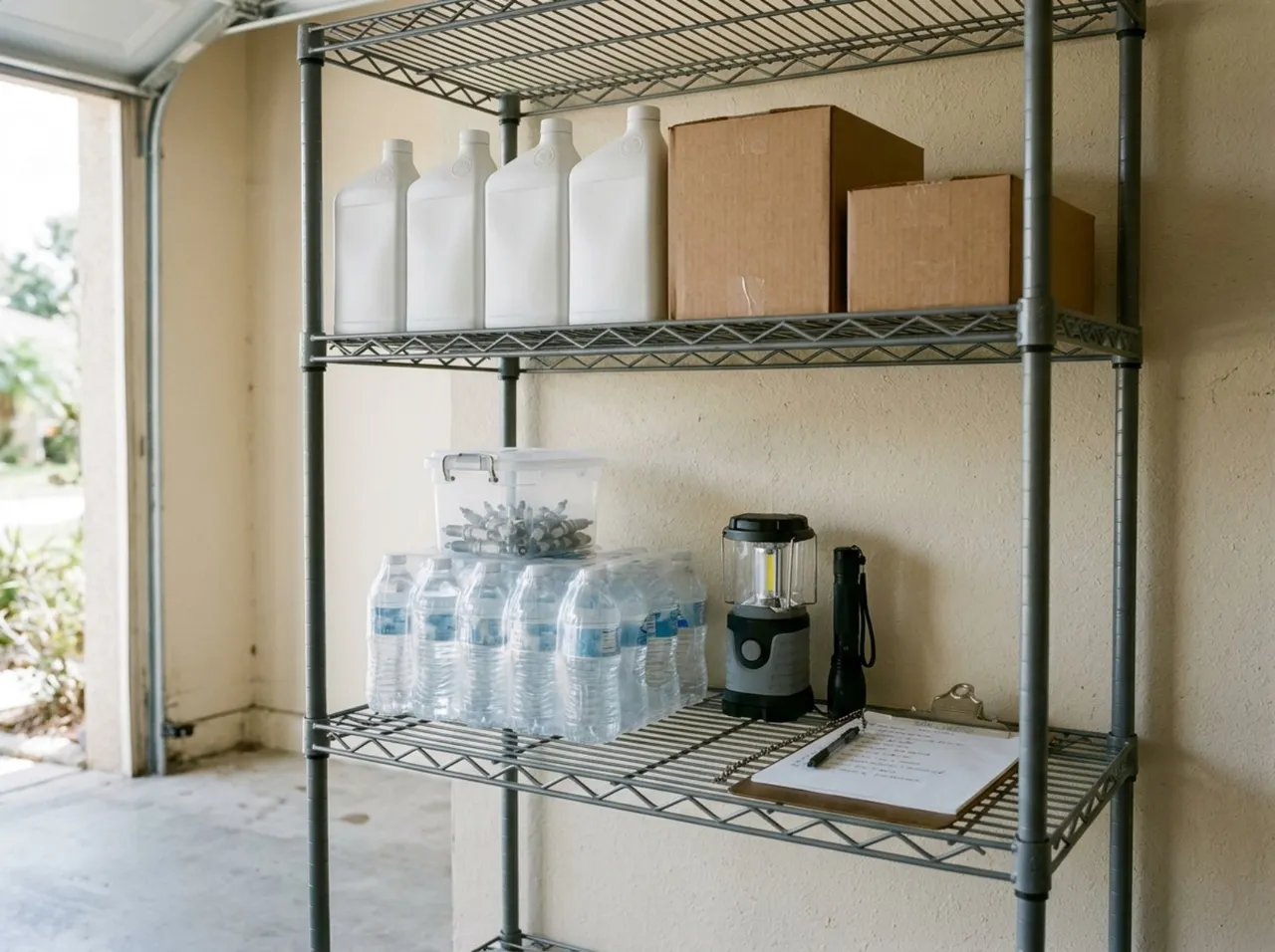
The fix is simple and cheap: keep the supplies on a shelf before the season starts.
- Several quarts of the oil your manual names (Generac lists about 1.9 quarts of 5W-20 per change on its 20 to 26 kW units).
- Two or more oil filters, plus a spare air filter and spark plugs.
- A funnel, rags, gloves and a flashlight.
Your owner's manual says which tasks it expects an owner to handle. Anything beyond that, or anything you would rather not do, goes to your installer. The long-outage maintenance page has the full schedule and safety steps.
Water, food and medicine: what no generator stores
A generator keeps the refrigerator cold. It does not fill the pantry, store water or refill a prescription. Those layers come from you, and they cost very little.
Water. Florida's checklist asks for 1 gallon of water per person per day, and food for at least 7 days. For two people, that is 14 gallons on a shelf. The Villages District also issues precautionary boil water notices after line breaks or plant problems; residents boil water for 1 minute, and clearing a notice usually takes about two days of lab sampling. Stored water covers those days too.
Food. The FDA says a closed refrigerator keeps food cold for about 4 hours and a full freezer holds about 48 hours, or about 24 if half full. With a generator those clocks stop mattering. Without one, or while a unit is down for an oil change, keep the doors closed. Stock shelf-stable food that needs no cooking for at least part of the week.
Medicine. Ready.gov says refrigerated medicine should be thrown out after an outage of more than a day unless the label says otherwise. The FDA says insulin, opened or not, can be kept unrefrigerated between 59 F and 86 F for up to 28 days. Keep a written list of medicines and doses, and ask your pharmacist about an extra supply before the season.
Cash, phones and paper. Card readers and cell service can be spotty after a storm. Keep some cash, a car charger, and printed copies of important numbers and insurance details.
If anyone in the household depends on powered medical equipment, read backup power for medical equipment before the season. It covers the county special needs registries and what SECO Energy can and cannot promise.
Putting the plan together before the season
The Atlantic hurricane season runs from June 1 to November 30, and NOAA puts its peak on September 10. Every exterior generator in The Villages also needs approval from the district Architectural Review Committee before work begins, plus a county or city permit. That paperwork is the reason to start in winter or spring, not the week a storm is named.
Here is the order that works for most households:
- Decide what must run. Cooling, medical equipment, the kitchen. Use the sizing guide.
- Learn your fuel. Natural gas at the street, or propane in a tank that fits your lot. See natural gas vs propane.
- Get a free in-home estimate. One request matches you with a licensed local installer. See how it works.
- Clear ARC and the permit. Your installer prepares both. See ARC approval and permits.
- Stock the shelf. Oil, filters, water, food, medicine list, cash.
- Write the refill plan. Who delivers your propane, and when you call.
- Register if you qualify. County special needs registries are a backstop, not a guarantee.
Then the hard part is done. When the next long outage comes, the house shifts to the generator, the refrigerator keeps humming, and your job is a daily oil check and a cup of coffee on the lanai.
If you are still deciding whether a generator fits your home at all, the is it worth it page gives a straight answer, including who can skip one. Costs are laid out on whole-home generator cost.
Request your free estimate and start the ARC clock this season
Straight answers
Free in-home estimate, written price, no obligation.
Get my estimateHow long should a household in The Villages plan to be without power?
Florida's Division of Emergency Management asks households to keep food and supplies for at least 7 days. Locally, Milton outages cleared in about four days and Irma's statewide outages fell below 1 percent ten days after the peak. A one-week plan with a path to two weeks covers every local storm in the PSC record.
Will a whole-home generator run my house for a week?
It can, if the fuel lasts. On natural gas there is no tank to run dry. On propane, a full 120-gallon tank runs a 26 kW Generac about 1.9 days at half load, so a week needs a larger buried tank where your lot can fit one, a refill plan, load management, or a smaller unit. Your installer works out the numbers for your home.
What does a generator not take care of in a long outage?
It does not store water, food or medicine, and it needs its own fuel and oil. Plan 1 gallon of water per person per day, a week of food, a written medicine list, cash, and enough oil and filters for at least one change. A generator is one layer of the plan, not the whole plan.
Do I need ARC approval before installing a standby generator?
Yes. The district ARC manuals checked require an application for permanently affixed generators, with rules on placement, screening and exhaust, and approval before work starts. A county or city building permit is also needed. Your installer prepares both and confirms the rules that apply to your district and address.
When is the best time to install a generator in The Villages?
Before hurricane season, which NOAA dates from June 1 to November 30 with a peak around September 10. ARC review and the permit both take time, so starting in winter or spring gives the work room to finish before the busiest storm weeks. Waiting until a storm is named leaves no time at all.
Are multi-week outages likely in The Villages?
The local PSC record does not show one. Milton cleared in about four days and Ian in about four. Multi-week outages after Michael, Ian in Lee County and Helene in western North Carolina happened elsewhere and are lessons in how damage can stack up, not predictions. Planning for a week, with a path to two, is a calm and sensible target.