How an automatic transfer switch works
The transfer switch is the part of a standby system you rarely see and never touch. It decides when your home leaves the grid, what runs first and when it is safe to go back.
Hurricane Milton, Oct 10, 2024
21,912Sumter County electric customers out, 23.0% at the Florida PSC 8:47 AM report
Or call (352) 780-1430. A licensed installer who serves your area calls back, usually within one business day.
Watch the switch do its job
Press the button to cut the grid. The transfer switch disconnects your house from the utility line and connects it to the generator, then switches back when the grid returns.
Grid power on: the generator waits and runs a short self-test each week.
What the switch does when the grid goes down
Free in-home estimate, written price, no obligation.
Get my estimateAn automatic transfer switch, or ATS, sits between the utility, your generator and your home's wiring. Its job is to connect your house to one source at a time, never both, and to make the change without anyone lifting a finger.
Here is the sequence on a Generac 26 kW system, using the figures on its spec sheet:
- It watches the utility voltage. The controller monitors the incoming power all the time.
- It waits. When power drops, a utility interrupt delay prevents nuisance starts on a quick flicker. The factory default is 5 seconds, and a qualified dealer can set it anywhere from 2 to 1,500 seconds.
- It starts the engine. The engine warms up for about 5 seconds to make sure it is ready for the load.
- It transfers. The switch disconnects your home from the utility and connects it to the generator.
- It manages. Load management brings large loads, like the air conditioner, on in turn.
- It returns. When utility power comes back and holds steady, the switch moves your home back to the grid, and the generator cools down and shuts off.
Generac's support article says both types of switch, service-rated and not, do this automatically: they move your home to standby power when the utility fails and back when it is restored.
For you, the experience is a short blink of darkness and then the house carries on. That matters most at 3 AM, in a storm, or when nobody is home. A seasonal resident in another state still comes back to a cold refrigerator and a dry house.
It also matters for safety. Because the switch connects one source at a time, your generator is not feeding power back toward the utility lines.
Service-entrance rated or not: which one your panel needs
Transfer switches come in two main types, and the one you need depends on how your home's electrical service is built. Generac's support article explains the difference, and stresses that it is about where the switch is installed, not about quality.
Service-entrance rated. This switch sits just after the utility meter and is the first disconnect after it. It includes a service disconnect, often with a breaker for overcurrent protection, and is approved to act as the home's main disconnect. It can cut power to the whole house. The switch packaged with Generac's 26 kW unit is this kind: 200 amps, 120/240 volt single phase, in an outdoor-rated aluminum enclosure that can also mount indoors. Its main breakers are rated for 80% continuous load. Generac also offers service-entrance switches with built-in surge protection.
Non-service-entrance rated. This switch has no service disconnect of its own. It is installed downstream of the main disconnect, working like a subpanel, and the utility disconnect lives in a separate box or in your main panel.
Which is right depends on your electrical configuration, the type of service, whether a separate service disconnect already exists, and the local, state and national codes the building department enforces. That is a call for your licensed installer, and the inspector checks it.
Size matters as well. Generac's residential switch line runs from 100 amps to 400 amps and beyond. Most homes need a switch that matches the main service. Your installer reads your panel's rating at the estimate.
If your home was built in the earlier years of The Villages, bring any panel changes you know about. It helps the installer plan.
Load shedding modules: the quiet fuel saver
Load management lives in and around the transfer switch, and for a long outage it may be the most valuable part of the system.
Here is what each major brand documents:
- Generac. The service-rated switch with the 26 kW unit manages up to four air conditioner loads with no added hardware. Add Smart Management Modules (a 50-amp G007000-0 or a 100-amp G007006-0) and it can manage up to eight more large 240-volt loads. SMMs manage large loads at startup and shed them to help the generator recover when overloaded. An auxiliary contact kit can lock out one large load that is not needed.
- Kohler (Rehlko). A load shed kit inside its RDT or RXT switch, or a load management board, manages up to six loads: two relays for two independent AC loads and up to four power relay modules. The RDC2 controller adds or sheds loads by priority.
- Cummins. The RS20A controls up to four loads and restores only what the generator can run.
Why this saves fuel: generators burn more as load rises. Generac's 26 kW unit uses 2.06 gallons of propane an hour at half load and 3.63 at full load. With a 120-gallon above-ground tank, the cap in the district ARC manuals, that is the difference between about 47 hours and about 26 hours from a full tank.
Load shedding keeps the water heater, dryer and second AC from all running at once. The house stays comfortable and the fuel lasts longer. For a home on natural gas, it also keeps demand within what the meter and regulator can deliver.
Our sizing guide covers how to set priorities.
At 6 AM on October 10, 2024, after Hurricane Milton, SECO Energy reported 13.9% of its 75,252 Sumter County accounts without power, per the Florida PSC.
The weekly exercise and what it tells you
A standby generator spends most of its life waiting. The exercise cycle keeps it ready, and listening to it is the easiest check a homeowner can make.
Each brand handles it a little differently, per its documents:
- Generac. A 5-minute exercise you can set weekly, every other week or monthly. Generac says it runs the engine to prevent oil seal drying and damage between outages. In Quiet-Test low-speed mode, the 26 kW unit measures 57 dB(A) at 23 feet, against 67 dB(A) at normal load.
- Kohler (Rehlko). A weekly 20-minute unloaded exercise with diagnostics, plus a 90-second Eco Exercise that Kohler says reduces fuel use and sound. The 26RCA measures 56 dB(A) during exercise. It burns about 67 cubic feet of natural gas or 31 of propane an hour while exercising.
- Briggs & Stratton. The PP26 exercise is programmable from 16 seconds, the default, up to 20 minutes.
An unloaded exercise, like Kohler's weekly cycle, runs the engine without moving your house to generator power, so you hear it but the lights do not blink. Kohler also lists a loaded mode. Ask your installer which mode your system uses.
Pick an exercise time that is kind to neighbors, such as late morning on a weekday. Noise is one of the most common generator complaints on the resident forums, and a thoughtful schedule goes a long way. Our noise page has more.
Many units can send exercise results and maintenance alerts to your phone. If an exercise is skipped or fails, you hear about it on a calm Tuesday instead of during a storm.
Placement, ARC rules and the permit for the switch
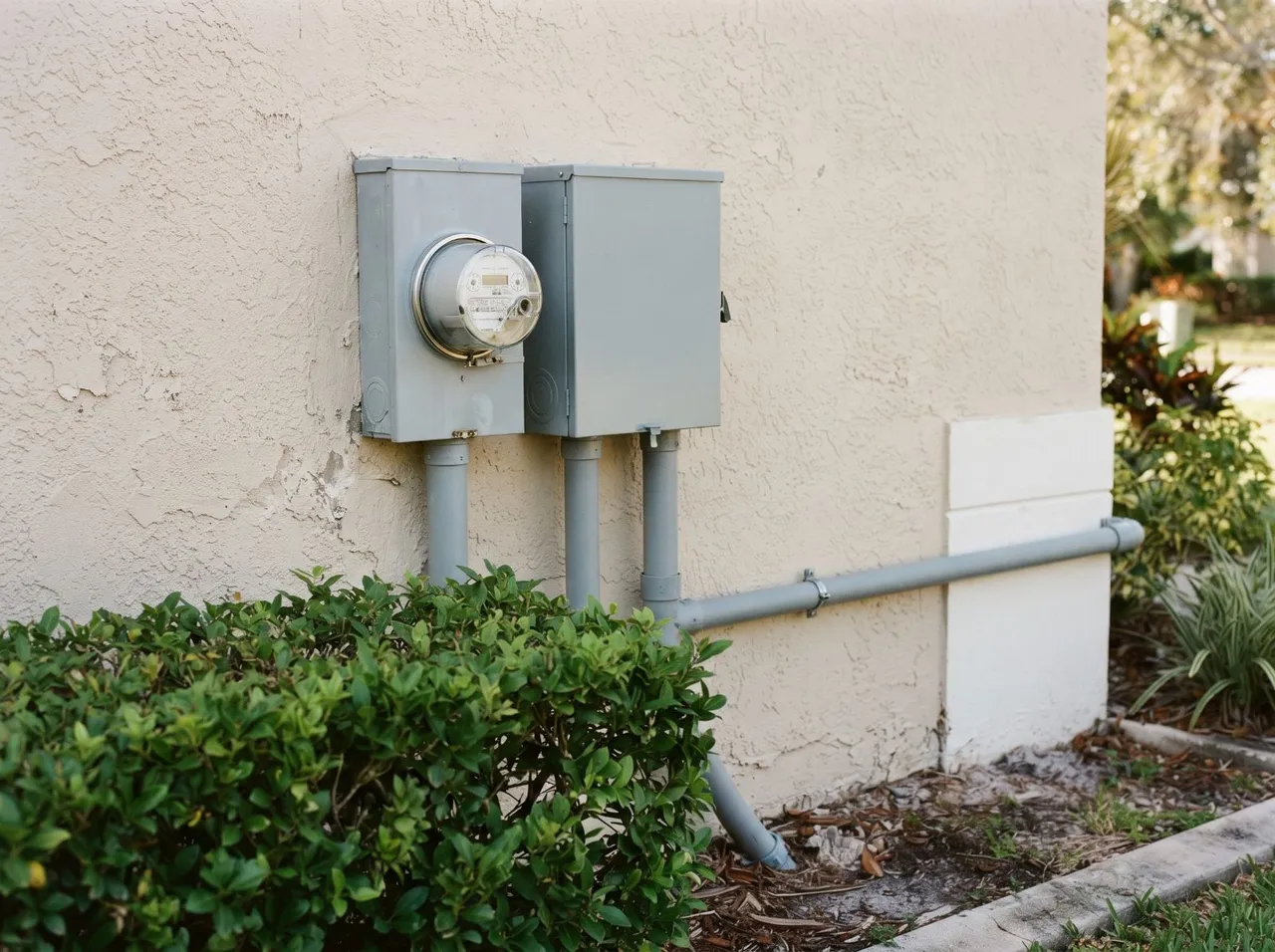
The transfer switch usually mounts on the outside wall near the electric meter, or inside the garage beside the panel. Generac's service-rated switch uses a NEMA 3R outdoor enclosure that allows either.
The generator is what the ARC rules focus on. In the district ARC manuals checked for this site (District 1, District 8, District 11 and CDD No. 4), a permanently affixed generator needs an application. It goes at the rear or side, at least 2 feet from property lines and out of street view, with screening no taller than the unit and exhaust pointed away from neighbors. Each manual also says architectural approval is required for exterior modifications. A switch on an exterior wall is part of the same project, so your installer includes it in the plan. See our ARC approval guide.
The electrical work needs a building permit from the office that covers your address, which in The Villages may be Sumter County, the City of Wildwood, Lake County or the Town of Lady Lake, or Marion County. The inspector checks the switch, the connections and the grounding. Our permit page explains the offices.
Distance matters for cost. The farther the generator sits from the switch, the longer the wire run. On a villa with a narrow side yard, the installer may need to balance a spot that meets the ARC setbacks and the manufacturer's clearances with a reasonable run to the meter. Our villa page covers it.
Once it is in, the switch needs little from you. Keep the area around it clear and leave the cover closed.
Portable generators and manual switches: the honest comparison
Some residents on the local forums ask whether a portable generator and a manual switch can do the same job for less. For a short outage and a household that can handle it, it can be a reasonable choice. For a long outage, it helps to be clear about the differences.
Someone has to be there. A manual setup needs a person to move the generator outside, start it, connect it and switch over. That is harder in the dark, in the rain, or for someone with limited mobility. It does nothing for an empty home.
Fuel handling. Most portables run on gasoline, which needs refueling every several hours and has to be bought and stored. A standby unit runs from your gas meter or propane tank.
Carbon monoxide. The CDC says to run generators outdoors more than 20 feet from windows, doors and vents, and never in a garage, even with the door open. CPSC links about 92 consumer product carbon monoxide deaths a year to portable generators. After Florida's 2004 hurricanes, CDC found portable gasoline generators caused 96% of nonfatal carbon monoxide incidents with a known source. A permanently installed standby unit is placed and vented for outdoor operation.
Load management. Portables usually power a handful of circuits. An automatic switch with load management can run the whole house, the air conditioner included, by taking loads in turn.
If a portable is your plan, use a transfer switch or interlock installed by a licensed electrician, never a backfeed cord, and keep battery-backed carbon monoxide alarms on every level. Our portable vs standby page compares them in full.
Compare a standby system with your current plan at a free estimate
Straight answers
Free in-home estimate, written price, no obligation.
Get my estimateWhat does an automatic transfer switch do?
It connects your home to one power source at a time. When utility power fails, it waits a short delay (5 seconds by default on a Generac 26 kW), starts the generator, lets it warm up and moves your home to generator power. When the utility returns and holds steady, it switches you back and the generator shuts off on its own.
What is a service-entrance rated transfer switch?
It is a switch installed right after the utility meter that includes its own service disconnect and is approved to act as the home's main disconnect. A non-service-entrance rated switch has no disconnect and installs downstream of one, like a subpanel. Generac says neither is better; your installer picks the type that fits your service and the codes the inspector enforces.
Will the transfer switch run my whole house?
A whole-house switch sized to your service, usually 200 amps, can connect the entire panel. Whether everything runs at once depends on the generator size. Load management in or beside the switch starts big loads in turn and sheds low-priority ones, so a managed system can run the whole house, the air conditioner included.
What are load shedding modules?
They are relays or modules that turn large loads off and on so the generator is not overloaded. Generac's Smart Management Modules come in 50-amp and 100-amp sizes and work with its switch to manage up to eight large 240-volt loads beyond four AC loads. Kohler's kit manages up to six loads. Shedding also stretches propane during a long outage.
Why does my generator run every week?
That is the exercise cycle. It keeps the engine lubricated and confirms the system is ready. Generac runs a 5-minute exercise weekly, every other week or monthly. Kohler offers a weekly 20-minute exercise with diagnostics and a 90-second Eco Exercise. Your installer can set a time that suits you and your neighbors.
Does the transfer switch need ARC approval or a permit?
The electrical work needs a building permit from the office that covers your address, and the inspector checks the switch. The generator itself needs an ARC application in the district manuals checked, and the switch is part of that same exterior project. Your installer includes both in the paperwork and confirms the rules for your district.