Florida's power grid, in plain words
You do not need to worry about the grid to prepare for an outage. Here is what the regulators actually say about Florida's power system, and what it means for a home in The Villages.
Hurricane Milton, Oct 10, 2024
21,912Sumter County electric customers out, 23.0% at the Florida PSC 8:47 AM report
Or call (352) 780-1430. A licensed installer who serves your area calls back, usually within one business day.
What NERC says about Florida's grid
Free in-home estimate, written price, no obligation.
Get my estimateThe North American Electric Reliability Corporation, NERC, is the body that assesses whether there is enough power supply across the US and Canada. Its reports are the best place to start, because they are written by engineers, not by people selling anything.
In its 2025 Long-Term Reliability Assessment, released in January 2026, NERC found that 13 of 23 assessment areas face resource adequacy challenges over the next ten years. Florida is not one of them. The SERC-Florida Peninsula area shows a normal level of risk in NERC's probabilistic studies for 2027 and 2029. In more than 5,000 simulated cases, only one, using extreme 1985 weather, showed any unserved energy, 720 megawatt-hours on a December morning.
The near-term reports agree:
- Summer 2026: NERC's Summer Reliability Assessment showed no unserved energy or loss-of-load hours for the Florida Peninsula.
- Winter 2025-26: Florida entities identified no emerging reliability issues, with a 39 percent anticipated reserve margin, and reported strong fuel security from firm gas contracts, storage, pipeline capacity and managed coal and oil inventories.
NERC does flag one thing to watch. Florida's anticipated reserve margin falls below the reference level around 2035, and the state leans heavily on one fuel, which the next section covers.
The plain reading: Florida's bulk power supply is in good shape by NERC's measure. The long outages Florida households actually experience come from somewhere else, and that is where a home plan should focus. The long-term preparedness plan is built around that local risk.
Natural gas dependence, NERC's noted concern
About 48,214 of Florida's 64,849 megawatts of projected 2026 capacity, roughly 74 percent, runs on natural gas, according to NERC's 2025 Long-Term Reliability Assessment. NERC notes that this heavy reliance could make fuel diversity a future concern, and that adding more solar would not help on extreme winter mornings, when demand peaks before sunrise.
NERC also explains why gas is different from coal or oil at a power plant: it is a just-in-time fuel. It is infeasible or very costly to stockpile at the plant, so plants depend on pipelines delivering it as they burn it. NERC adds that many generator owners in Florida and the Northeast keep backup fuel at critical gas-fired plants.
The cautionary example is Texas in February 2021. The FERC and NERC staff report on Winter Storm Uri found that 1,045 generating units had outages, derates or failures to start. Freezing caused 44.2 percent and fuel problems 31.4 percent, and natural gas supply problems made up 87 percent of the fuel issues. More than 4.5 million people lost power, some for as long as four days in below-freezing cold.
It is fair to ask whether that could happen here. NERC's own answer, in its 2025-26 winter assessment, is that Florida entities reported strong fuel security. Uri was an extreme cold event in a different grid with different contracts. It is a lesson in why fuel matters, not a prediction for Florida.
For a household, the takeaway is modest. If your generator runs on natural gas, you share the same fuel as most of the state's power plants, delivered through a separate local distribution system. Residential gas service normally holds firm supply contracts, per the FERC-NERC report. The natural gas vs propane page weighs that against a propane tank.
Ask your installer how your fuel choice fits a long-outage plan
DOE and EIA: the national picture, and Florida's place in it
Two more federal sources round out the picture, and both point to the same answer for Florida.
The US Department of Energy published a grid reliability report in July 2025. It modeled 104 gigawatts of planned firm-capacity retirements by 2030 and found annual loss-of-load hours rising about a hundredfold nationally, from 8.1 to 817 hours a year. Outside analysts have disputed some of its assumptions. Within the SERC region, the shortfalls were concentrated in SERC-East, and the other subregions, including Florida, performed adequately. It is not a basis for alarm about Florida's supply.
The US Energy Information Administration tracks how long customers actually go without power. In 2024, the average US customer had about 11 hours of interruptions, the most in ten years and nearly twice the prior decade's average. Major events, chiefly Beryl, Helene and Milton, caused 80 percent of those hours. Outside major events, customers routinely see about 2 hours a year.
Florida's numbers show the same pattern in sharper relief. EIA's reliability table, using the IEEE method, lists Florida's average outage time at:
- 2,693.2 minutes in 2017, about 45 hours, the Irma year
- 1,011.3 minutes in 2022, about 17 hours
- 1,487.6 minutes in 2024, about 25 hours
- 72.7 minutes in 2025
Without major event days, Florida runs about 65 to 80 minutes a year. That is the key line for planning. In a normal year, Florida power is quite reliable. In a hurricane year, the average customer loses a day or two, and some lose much more.
A standby generator is not a hedge against a failing grid. It is a hedge against storm years, which arrive on no schedule. See hurricane backup power for the local storm record.
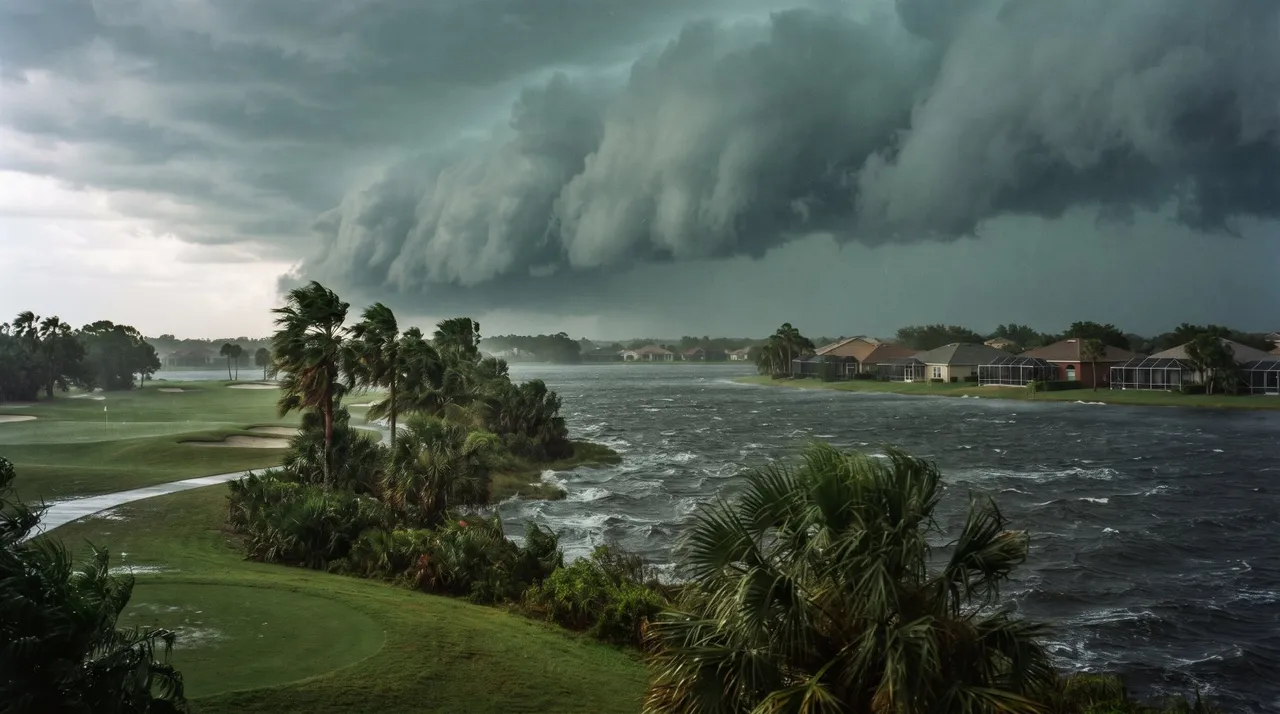
Hurricane Milton put 23.0% of Sumter County accounts out at the PSC's 9 AM report on October 10, 2024, an outage caused by storm damage, not by a shortage of power.
Underground lines on your street, storm damage upstream
A common view in The Villages is that outages are rare here because the lines on many streets run underground. That view is partly right. Day to day, local outages are short and infrequent, which matches EIA's Florida figure of about 65 to 80 minutes a year outside major events.
But your street is only the last stretch of a much longer system. Power reaches it through substations and feeder lines shared with the wider region, and a big storm tests all of it. The PSC record shows what happens:
- Milton, October 2024: SECO Energy accounts out at the PSC's 9 AM report on October 10 reached 15.95 percent in Sumter County, 60.48 percent in Lake and 28.90 percent in Marion. Across all utilities, Sumter peaked at 23.0 percent.
- Irma, September 2017: county peaks of 75.9 percent in Marion, 69.7 percent in Lake and 38.9 percent in Sumter, per the PSC's 2018 review.
The PSC's review of Irma found vegetation, often trees outside utility rights of way, was the largest cause of outages. The PSC also says plainly that no amount of preparation can eliminate outages in extreme weather, so regulators work to reduce and shorten them.
NERC's winter assessment adds one more detail: during Milton and Helene, Florida utilities faced energy emergencies caused by extended outages at their own generating plants, compounded by high loads in the January 2025 cold, yet still served firm load.
The lesson for a household is clear and calm. Underground service on your street helps a lot with everyday reliability. It does not make a home immune to a hurricane. The is it worth it page walks through that decision honestly.
Check your county's storm record before deciding you are covered
What restoration actually looked like locally
Grid reliability is about how often power goes out, and also about how fast it comes back. Here the local record is reassuring, and it is worth stating exactly.
- Milton, 2024: Sumter County went from 18,253 accounts out on the evening of October 10 to 294 on October 13 and zero on October 14. Lake and Marion followed the same curve, near zero about four days after the peak.
- Ian, 2022: locally, Lake County peaked at 18.57 percent and was at zero by October 3, about four days after the peak. Sumter and Marion cleared faster.
- Helene, 2024: Marion peaked at 20.36 percent, Lake at 3.43 and Sumter at 1.87, and the PSC reports show all three cleared within about two days.
- Irma, 2017: the statewide share still out fell below 1 percent only ten days after the peak.
One caution from the PSC record itself: a county showing zero can also mean a utility stopped reporting at very low numbers, so the last few homes on any street may wait longer than the county total suggests.
Restoration times elsewhere have been far longer. After Michael in 2018, Panhandle counties took about 26 days to reach zero. After Ian, Lee County was still 1.52 percent out almost four weeks later. After Helene, about 11,500 North Carolina co-op members were still out roughly two weeks on. Those storms struck other places with other damage, and they are lessons, not forecasts.
A sensible local plan therefore covers about four days easily and a week comfortably, with a path to stretch further. That is exactly the target in the long-term preparedness plan and the fuel math on generator fuel runtime.
Size your fuel plan to cover four days easily and a week comfortably
What this means for your household
Put the regulators' findings side by side and a clear, calm picture emerges.
- Bulk supply is sound. NERC rates the Florida Peninsula at normal risk for the coming years and found no unserved energy for summer 2026. DOE found Florida adequate.
- Storms are the real risk. EIA's data shows Florida's outage hours spike in hurricane years and stay low otherwise. Milton and Irma both left large shares of local accounts dark for days.
- Restoration here has been measured in days. About four days for Milton and Ian locally, ten days statewide after Irma.
- Fuel diversity is worth a thought. NERC flags Florida's reliance on natural gas as something to watch. At home, that is a reason to know your own fuel's strengths and limits, whether a gas line or a propane tank.
So the household plan does not need to be dramatic. It needs a generator sized for the essentials, fuel for about a week through natural gas, a larger buried tank where the lot allows, or a refill plan, oil and filters on the shelf, and water and food for seven days. That is a well-stocked pantry approach, not a bunker.
The rest of this guide fills in each piece:
- How long a generator runs on propane
- Maintenance during long outages
- Keeping the AC running
- Backup power for medical equipment
- Generator vs battery backup
When you are ready, one request matches you with a licensed local installer for a free in-home estimate, with no obligation to buy.
Straight answers
Free in-home estimate, written price, no obligation.
Get my estimateIs Florida's power grid reliable?
By NERC's measure, yes. Its 2025 Long-Term Reliability Assessment rates the Florida Peninsula at normal risk, and its 2026 summer assessment found no unserved energy for Florida. EIA data shows Florida customers average about 65 to 80 minutes of outages a year outside major events. The long outages Florida sees come mainly from hurricanes damaging lines.
Is Florida at risk of rolling blackouts like Texas in 2021?
NERC does not flag Florida for that risk. Its 2025-26 winter assessment reported strong fuel security in Florida, with a 39 percent anticipated reserve margin. Winter Storm Uri was an extreme cold event on a different grid. NERC does note Florida's heavy reliance on natural gas as a fuel diversity concern to watch in future years.
Why do outages still happen if lines are underground in The Villages?
Your street is only the last stretch of the system. Power still travels through substations and feeder lines shared with the wider region, and big storms damage parts of it. Milton put 23.0 percent of Sumter County accounts out at the PSC's 9 AM report on October 10, 2024. The PSC found trees were the largest outage cause in Irma.
How long do outages usually last in The Villages area?
Outside storms, briefly. EIA lists Florida at about 65 to 80 minutes a year without major events. In storms, longer: Milton and Ian cleared in about four days locally, Helene in about two, and Irma's statewide outages took ten days to fall below 1 percent. A one-week household plan covers that record with room to spare.
How much of Florida's power comes from natural gas?
NERC's 2025 Long-Term Reliability Assessment lists about 48,214 of 64,849 megawatts of Florida's projected 2026 capacity as natural gas, roughly 74 percent. NERC notes that heavy reliance could make fuel diversity a future concern. It also reports that many Florida plant owners keep backup fuel at critical gas-fired plants.
Should grid reports change whether I buy a generator?
They should change what you plan for, not create alarm. The reports say Florida's bulk supply is sound and that storms drive long outages. So the useful question is whether your home can ride through a multi-day storm outage. If heat, medical equipment or food matters to you, a generator with fuel for about a week answers that question.