Propane tank limits in The Villages
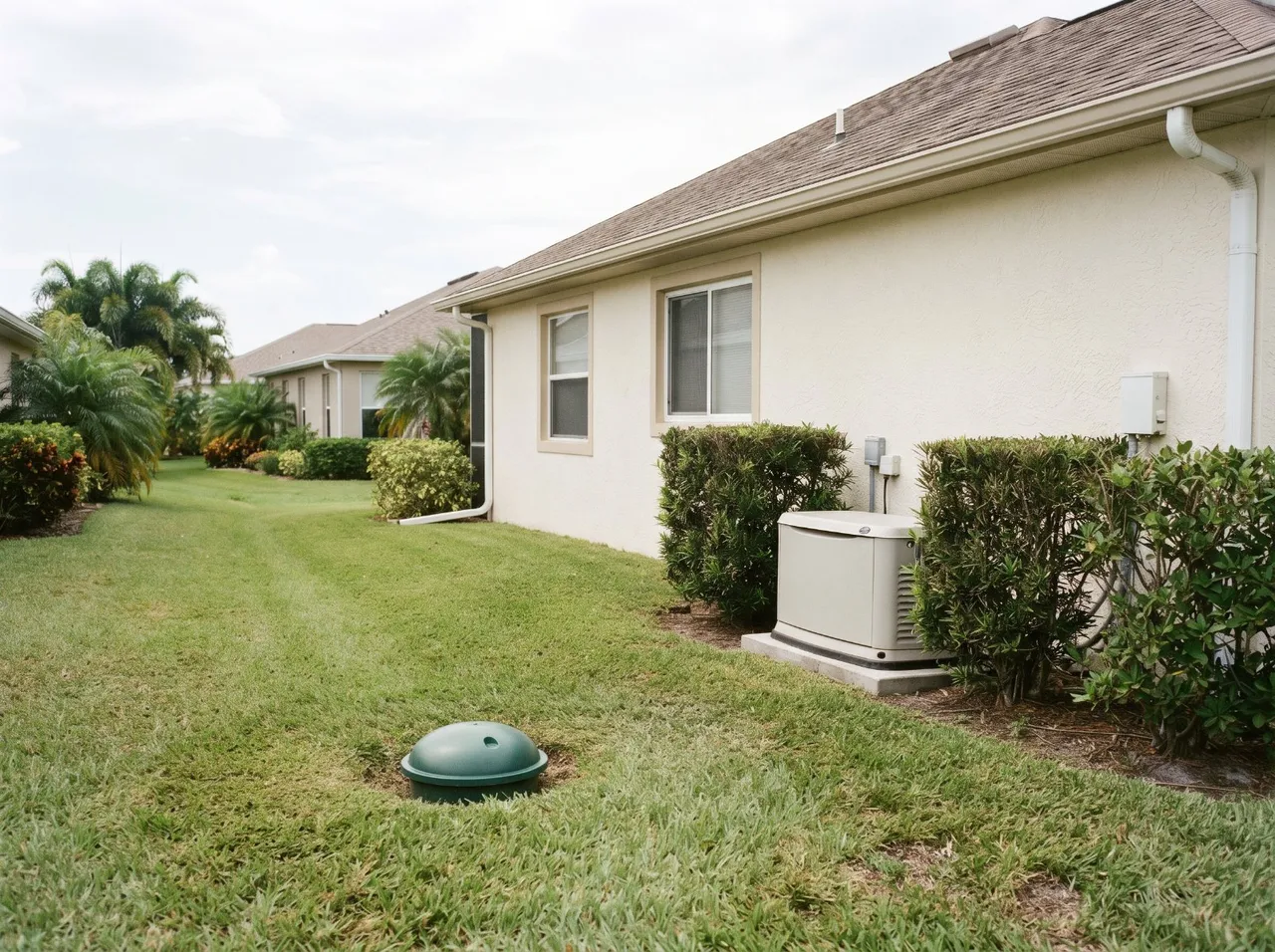
The district ARC manuals cap an above-ground propane tank at 120 gallons. That is about two days of generator power at a typical load. Here is the honest math and how Villages households plan around it.
Hurricane Milton, Oct 10, 2024
21,912Sumter County electric customers out, 23.0% at the Florida PSC 8:47 AM report
Or call (352) 780-1430. A licensed installer who serves your area calls back, usually within one business day.
How long the fuel lasts
Days of running at half load for a 26 kW generator, by fuel supply. Propane tanks are filled to 80 percent, so a 120-gallon tank holds about 96 gallons.
120-gallon propane tankthe above-ground limit in the district ARC manualsabout 1.9 days
250-gallon buried tankwhere setbacks and easements allowabout 4.0 days
500-gallon buried tankwhere setbacks and easements allowabout 8.1 days
Natural gas from the streetwhere a gas main reaches the homeas long as gas flows
What the ARC manuals actually say about propane tanks
Free in-home estimate, written price, no obligation.
Get my estimateThe propane rule is short, and every word matters. The current manuals on districtgov.org in October 2026, including the District 1, District 8 and CDD No. 4 manuals and the Lady Lake/Lake County manual, use nearly identical wording:
- Both kinds are allowed. Underground or above-ground L.P. tanks are permitted.
- Above-ground tanks need approval. Architectural approval is required for an above-ground tank.
- One tank, 120 gallons. Above-ground tanks are limited to one tank that cannot exceed 120 gallons.
- Hidden and clear of easements. The tank must not be visible from the road or the neighbor's property and cannot encroach on a utility or use easement.
- Screening no taller than the tank. Landscaping or a fence may screen it; a fence can be no higher than the tank.
- All tanks follow the law. Every L.P. tank must meet local, state and federal rules, including easement rules.
Notice what the text does and does not say. The 120-gallon cap is written for above-ground tanks. The manuals do not state a size for a buried tank. That does not mean a large buried tank is easy. Fire code setbacks, easements and lot size usually decide that, as the section on buried tanks below explains.
Manuals change, and Districts 13 to 16 use a separate developer manual with slightly different wording. Ask Community Standards how your district reads the rule for your lot before you build a plan around any tank size. The District's Architectural Review page lists the contact line.
What 120 gallons means in hours and days
Propane tanks are never filled to the top. Liquid propane expands as it warms, so suppliers fill to about 80% of the tank's capacity, per Ferrellgas. A 120-gallon tank holds about 96 usable gallons.
Now the burn rate. The Generac 26 kW spec sheet lists 2.06 gallons an hour at half load and 3.63 at full load. Here is what that means:
- Generac 26 kW, half load: 96 gallons lasts about 47 hours, about 1.9 days.
- Generac 26 kW, full load: the unit burns about 87 gallons a day, so a full 120-gallon tank lasts barely a day.
- Generac 22 or 24 kW, half load: 2.53 gallons an hour, about 38 hours from a full 120-gallon tank.
Bigger tanks change the picture, where a lot can hold one:
- 250 gallons: about 200 usable gallons, about 97 hours or 4.0 days on the 26 kW at half load.
- 500 gallons: about 400 usable gallons, about 194 hours or 8.1 days.
These figures assume a constant half load around the clock and a tank that starts full. Real homes swing between light and heavy loads. A cool night uses less; an afternoon with two air conditioners cycling uses more. Generac also asks for a 30-minute shutdown every 24 hours of continuous running to check oil, which stretches calendar time slightly.
Compare that with the outage record. After Milton in 2024, Sumter County outages fell from a peak of 21,912 accounts on Oct. 10 to zero by the evening of Oct. 14 in Florida PSC reports. A two-day tank does not cover a four-day restoration by itself. That gap is what the rest of this page is about.
Buried tanks: allowed by the manual, limited by the yard
Since the manuals permit underground tanks and do not state a size for them, many homeowners ask about burying a 250 or 500 gallon tank. It can work on some lots. On many Villages lots it will not, and here is why.
- Setbacks from the house and lot line. A fire marshal summary of NFPA 58 lists 10 feet from a building or buildable property line for underground tanks of any size up to 2,000 gallons. By comparison, an above-ground tank under 125 gallons has no minimum separation in the same table. That is one reason the 120-gallon above-ground tank is so common here.
- Ignition sources. PERC's technical guide, reprinting NFPA 58 figures, says the fill connection of a tank filled on site must be at least 10 feet from ignition sources such as a window air conditioner or compressor, and from air intakes.
- Size in the ground. PERC lists typical dimensions of about 30 inches by 7 feet 8 inches for a 250 gallon tank and 38 inches by 10 feet for a 500 gallon tank.
- Truck access. PERC advises placing tanks where the delivery truck can reach them without driving over septic tanks or other buried features.
- Easements. The ARC manuals keep tanks out of utility and use easements, which take up much of a small lot.
The edition of NFPA 58 Florida enforces, and any local amendment, is checked by your installer and propane supplier, and the setback summary above is not a ruling for your lot. If a buried 250 gallon tank fits and the ARC agrees, it roughly doubles your runtime. If it does not fit, the answer is load management, a refill plan, or natural gas.
At Irma's peak in 2017, 38.9% of Sumter County accounts lost power (Florida PSC 2018 hurricane review), and statewide outages took about ten days to fall below 1%.
Refills during and after a storm
A small tank turns refills into the plan, so the plan has to hold up when the roads are a mess.
Irma showed how tight supply can get. The Florida Propane Gas Association, quoted by Butane-Propane News in October 2017, said Florida has limited propane storage, many bulk plants had no power to pump propane out, and with rail and ports down, trucks were the only way to bring propane into the state for about seven days. The state put backup generators, emergency kitchens and critical facilities first.
What that means for a Villages household:
- Start full. Top off before hurricane season and again when a storm is in the forecast. A tank that starts at half full gives you half the hours above.
- Know your supplier. Set up an account before the season and ask how they handle refills after a storm. No supplier can promise a time, and you should not expect one.
- Keep the path clear. The driver needs to reach the fill point. After a storm, that may mean clearing branches from the side yard.
- Watch the gauge. Call early. Many households set a reserve point and order well before the tank runs low, rather than waiting for empty.
- Check after a refill. Generac's continuous-use guidance asks for a daily stop to check oil and look over fuel lines. Use that stop to read the tank gauge too.
A refill plan is not a guarantee. It is what turns a two-day tank into a longer run when deliveries are possible, and it keeps you from being surprised when they are not.
Stretch the tank: right-size and manage the loads
The single biggest lever on propane runtime is how hard the generator works. Burn rates climb steeply with load. The Generac 26 kW goes from 2.06 gallons an hour at half load to 3.63 at full load, which is the difference between about two days and about one.
Three tools help:
- Load management. Generac's spec sheet says its 26 kW transfer switch can manage up to four air conditioner loads with no added hardware, and Smart Management Modules can shed large 240-volt loads so the generator recovers when overloaded. Kohler offers a load shed kit and load management board that can manage up to six residential loads by priority, per its owner manual. The idea is simple: the pool pump waits while the air conditioner runs.
- A right-sized unit. Smaller units burn less. Generac lists its 14 kW at 1.81 gallons an hour at half load, against 2.53 for the 22 and 24 kW. If what must run is the fridge, an oxygen concentrator, lights, the well-insulated bedroom and one air conditioner, you may not need the biggest box. The sizing guide helps you list it.
- Household habits. Run the dishwasher and dryer when the air conditioner is off. Keep doors closed. Pre-cool the house before the storm arrives.
For scale, an essentials load of a refrigerator at about 750 watts (DTE Energy's planning figure) plus an oxygen concentrator at about 350 watts (Philips EverFlo spec) is around 1.1 kW. That is a small fraction of a 26 kW unit's output. A propane plan built around what matters lasts far longer than one built around running everything.
When natural gas is the better answer
If a gas main reaches your home, natural gas usually beats propane for a long-outage plan here, for one reason: there is no tank to refill. The generator draws from the utility's buried line, and runtime is limited by engine maintenance rather than by 96 gallons.
Peoples Gas said in May 2025 that fewer than 1% of its more than 500,000 customers had a gas service interruption in the 2024 storms. That is the utility's own figure, and gas has its own limits, which our natural gas page covers honestly. But for a household that wants to ride out a week or more, it is the strongest option where it exists.
Here is a quick way to decide:
- You have a gas meter. Ask your installer to price natural gas first, with a utility check on the meter and regulator.
- No meter, gas on the street. Ask the utility about a service line and compare the cost with a propane setup.
- No gas available. Propane with a 120-gallon above-ground tank, load management and a refill plan, or a buried tank if your lot and district allow it.
- Medical needs. If someone in the home depends on oxygen or other powered equipment, build the plan for the longest outage you can, and register with your county's special needs program as well. A generator is one layer, not the only one.
The free estimate is where these options get priced side by side. Ask for the expected runtime in hours at your real loads written into the quote, for each fuel option, so you can compare honestly.
Straight answers
Free in-home estimate, written price, no obligation.
Get my estimateWhat is the propane tank size limit in The Villages?
The district ARC manuals limit an above-ground propane tank to one tank of no more than 120 gallons. It needs architectural approval, must be hidden from the road and neighbors, and cannot sit in a utility or use easement. Underground tanks are permitted and the manuals do not state a size for them. Confirm your district's current wording with Community Standards.
How long will a 120 gallon propane tank run a generator?
About 47 hours, roughly two days, for a Generac 26 kW at half load. Tanks are filled to about 80%, so a 120 gallon tank holds about 96 usable gallons, and the 26 kW burns 2.06 gallons an hour at half load per its spec sheet. At full load it burns about 87 gallons a day, so the tank lasts about one day.
Can I bury a bigger propane tank?
Possibly. The ARC manuals permit underground tanks and do not state a size limit for them. A fire marshal summary of NFPA 58 lists a 10 foot setback from the building and buildable property line for buried tanks, and easements still apply, which rules it out on many Villages lots. Your installer and propane supplier measure, and the ARC approves.
Why can't propane tanks be filled to 100%?
Liquid propane expands as it warms, so suppliers leave room in the tank. Ferrellgas says tanks are filled to about 80% of capacity, never 100%. That is why a 120 gallon tank holds about 96 gallons, a 250 gallon tank about 200, and a 500 gallon tank about 400. Plan runtime on the usable gallons, not the label.
Will propane be available after a hurricane?
Not always right away. After Irma, the Florida Propane Gas Association said many bulk plants had no power and trucks were the only way to bring propane into Florida for about seven days, with backup generators among the state's priorities. Start the season full, set up a supplier account early, and keep the fill point reachable for the driver.
How can I make a small tank last longer?
Lower the load. A Generac 26 kW burns 2.06 gallons an hour at half load and 3.63 at full load. Load management modules can hold back the pool pump or a second air conditioner, and a right-sized unit burns less to begin with. Running only what matters, such as the fridge, medical equipment and one air conditioner, stretches every gallon.