Generator ARC approval in The Villages
Every district in The Villages writes its generator rules down. Here they are in plain words, with the application steps and the papers your installer pulls together so the approval comes back clean.
Hurricane Milton, Oct 10, 2024
21,912Sumter County electric customers out, 23.0% at the Florida PSC 8:47 AM report
Or call (352) 780-1430. A licensed installer who serves your area calls back, usually within one business day.
Four to eight weeks, start to power
Most of the wait is paperwork and equipment. The work at your house usually takes one to two days.
Day 1
Free estimate
An installer visits, measures and leaves a written price.
Weeks 1 to 6
Permits and equipment
Electrical and gas permits, HOA approval where needed, the unit ordered.
1 to 2 days
Install
Pad, generator, fuel line and transfer switch go in.
Final week
Inspect and power on
Inspection passes, startup, a walkthrough of the controls.
The generator rules written in your district's ARC manual
Free in-home estimate, written price, no obligation.
Get my estimateYou do not have to guess what the Architectural Review Committee wants. The generator rules are printed in each district's ARC manual on districtgov.org. The current manuals for District 1 (revised August 2026), District 8 (August 2026), CDD No. 4 and the other districts in October 2026, and the generator section reads the same way across them.
In plain words, here is what the District 1 manual, the District 8 manual and the CDD No. 4 manual say:
- Only fixed units need an application. An Architectural Review application is required for a generator that will be permanently affixed to the property and the home. A portable unit you roll out of the garage is not covered by this section.
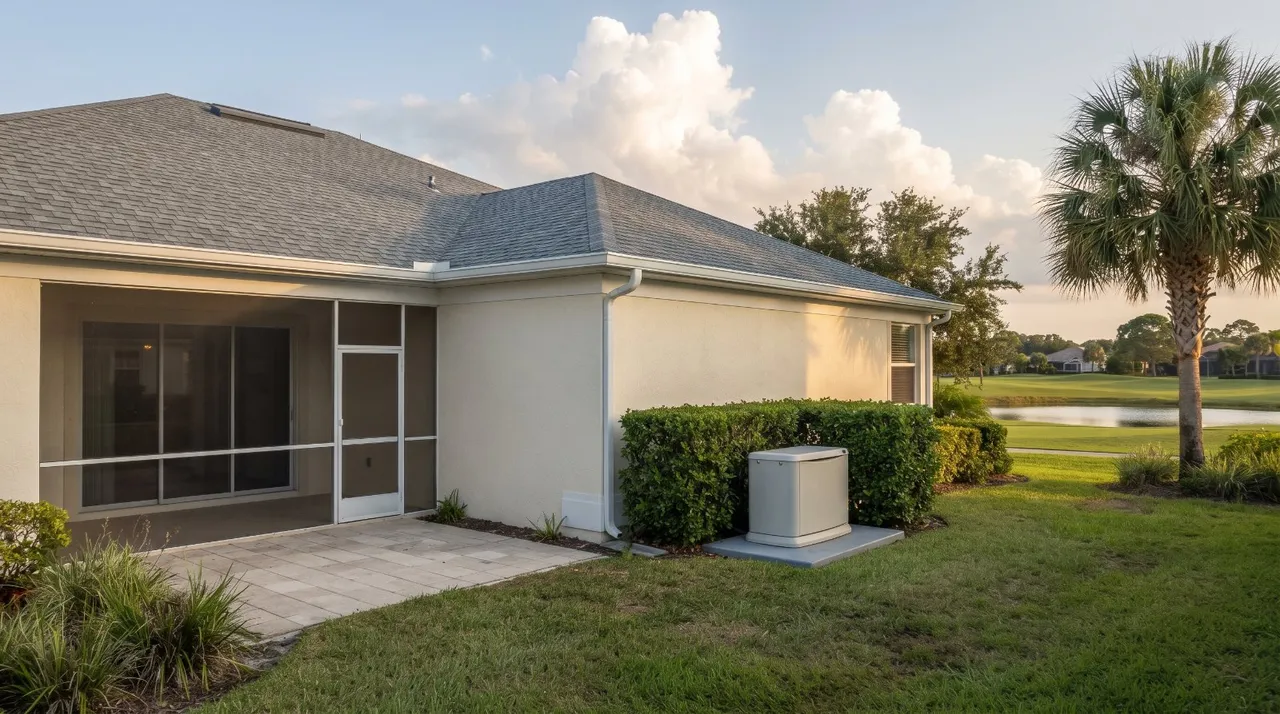
- Rear or side only. A fixed generator goes in the rear or side of the home site, never the front.
- Two feet from every line. The unit must stay at least 2 feet off all property lines.
- Out of sight from the street. It must not be visible from the street.
- Screening no taller than the unit. A fence may screen it, but the fence can be no higher than the generator.
- Exhaust away from neighbors. The exhaust must point away from the adjacent properties.
Every page of those manuals also carries the same footer: architectural approval is required for all exterior modifications unless the manual says otherwise. That covers the pad, the fuel line and any tank, not only the generator itself.
Manuals are revised often, and a few districts have their own wording. Districts 13 to 16 use a separate developer manual, for example. Your installer reads the manual for your district at the time you apply, and the ARC staff are the final word on how it applies to your lot.
Ask your installer to mark a spot that meets your district's manual
Pads, screening and propane tanks: the rules around the generator
The generator is only part of the picture. The same manuals have rules for the pieces that come with it, and they are worth knowing before anyone pours concrete.
- The pad. Concrete pads for air conditioners, pool equipment and generators "no larger than necessary" must stay 2 feet from the property lines, per the District 1 manual.
- Equipment in view. Pool pumps, air conditioners, mini splits, generators and related parts must be concealed when they can be seen from the street, using fences or landscaping, and must sit in the rear or side of the lot.
- Above-ground propane tanks. They need architectural approval. The manuals allow one above-ground tank of no more than 120 gallons. It must not be visible from the road or the neighbor's property and cannot sit in a utility or use easement. A screening fence can be no taller than the tank.
- Buried propane tanks. Underground or above-ground tanks are both permitted. The manuals do not state a size limit for a buried tank, but every tank must meet local, state and federal rules, including easement rules. Ask the ARC staff how your district treats a buried tank before you plan around one.
That 120-gallon figure shapes how long a propane generator can run here. On a 26 kW Generac at half load, a full 120-gallon tank holds about 96 usable gallons and lasts about 47 hours, roughly two days, by the spec-sheet math. Our propane tank limits page walks through what that means for a long outage, and the natural gas page covers homes where a gas main reaches the house.
Courtyard villas have extra easement clauses on top of all this, so they get their own page.
How the Architectural Review application works
The District's Architectural Review page lays out the paths. You can submit the Modification/Alteration form through the online portal, send it by email to [email protected], or use the mailing address the District lists, 3571 Kiessel Road, The Villages, FL 32163. Questions go to the Community Standards Department at (352) 751-3912, the number printed on that District page. Check the page before you call, since contact details can change.
A few things the District states plainly:
- There is no fee. The District says applications cost nothing to submit or review, and warns that any message asking for payment is fraudulent.
- Reviews happen in public. The Community Standards page says the Architectural Review Committee and a Hearing Officer review applications under each district's rules, and that more than 300 applications are reviewed each week. Committee meetings are held on Wednesdays and are open to the public under Florida's Sunshine Law.
- A site plan helps. The District points owners to their county or town building department for a copy of the building site plan, which shows the lot lines your generator has to clear by 2 feet.
The District page does not publish a review timeline, so do not count on a fixed number of days. Ask Community Standards what to expect for your district when you submit, and build that time into your schedule. If you want the generator running before the peak storm weeks, the simplest move is to start in the off season.
The homeowner is the applicant. Your installer can prepare the drawings and paperwork, but you sign, and the approval is tied to your home site.
Hurricane Milton left 23.0% of Sumter County accounts without power at the 8:47 AM report on Oct. 10, 2024 (Florida PSC), which is why approvals filed early in the year matter.
Approval first, then the permit, then the work
Order matters here. The District treats architectural approval as something you get before the work, not after it. A generator set on a pad before approval can leave you defending a finished project instead of a plan on paper.
Local building offices expect the same order. The City of Wildwood's development guide, for example, lists the steps for homes inside The Villages as ARC approval, then city zoning clearance, then the Sumter County building permit. Its brochure also notes that Wildwood sends all of its building permitting through Sumter County. That is one city's process, but it shows how the pieces stack: the community signs off on the look and the placement, then the government signs off on the safety.
A typical sequence looks like this:
- Estimate. A licensed installer measures the lot, picks a location that meets the manual and the manufacturer's clearances, and writes the quote.
- ARC application. You sign and submit, with the installer's site plan and the unit's spec sheet attached.
- Approval. The committee or Hearing Officer approves, approves with conditions, or asks for changes.
- Building permit. The installer applies with the right office for your address and pulls the permits under their own license. See the permits page for which office covers which part of The Villages.
- Install and inspect. Work happens, the inspector signs off, and the unit is started and tested.
If the ARC asks for a change, such as a different corner or a lower fence, ask your installer to price it in writing before anything moves.
What your installer prepares for the ARC
The District page does not post a required document list for generators, so a good packet answers the manual's rules one by one. When the reviewer can check each rule against a drawing, there is less back and forth.
Here is what a careful installer usually puts together:
- A marked site plan. The lot with the home, the generator pad and its distance to each property line, showing at least 2 feet clear.
- The view from the street. A note or photo showing the unit sits in the rear or side and cannot be seen from the road, plus the screening plan if a fence or plants hide it.
- Screening height. Fence height next to the generator height, so the reviewer sees the fence is no taller than the unit.
- Exhaust direction. An arrow showing which way the exhaust points, away from the neighbors' homes.
- The spec sheet. Brand, model, size and the enclosure dimensions. Generac lists its 10 to 26 kW air-cooled units at 48 by 25 by 29 inches on its spec sheets, for example.
- The fuel plan. The route of the gas line from the meter, or the location, size and screening of any propane tank.
- Color and photos. Photos of the spot, and the enclosure color if your district asks.
The installer also checks the manufacturer's own spacing. Generac's clearance guidance, citing NFPA 37, calls for 5 feet from operable windows, doors and vents, 5 feet of open space above the unit, and 3 feet at the front and both ends. Local codes take precedence. A spot has to satisfy both the ARC manual and the manufacturer, and the installer is the one who reconciles the two.
Portables, courtyard villas and other special cases
A few situations come up often enough to plan for.
- Portable generators. The manuals require an application only for generators permanently affixed to the property. A portable unit is a different tool with different risks. The CDC says to run one outdoors more than 20 feet from windows, doors and vents and never in a garage, even with the door open. Compare the options on our portable vs. standby page.
- Courtyard villas. The District 1 manual adds villa-specific easement rules: no modifications in the front yard area in front of the gate, no vertical structures in the dominant or servient side easements, and no vertical structures in the rear easement. Those clauses shrink the usable space fast. Read our courtyard villa guide before the estimate.
- Newer districts. Districts 13 to 16 use a developer manual with its own wording. Its propane clause, for example, also limits above-ground tanks to 120 gallons, but read your own manual rather than assume.
- Replacing an old unit. A new generator in the same spot is still an exterior change, and the new model may be larger or vent differently. Ask Community Standards whether your district treats it as a new application.
- Buying a home with a generator. Ask the seller for the ARC approval and the final permit inspection. Those two papers tell you the unit was placed by the rules.
When something does not fit neatly, call Community Standards at the number on the District page and ask before you build. A short call in March beats a deed compliance letter in August.
Straight answers
Free in-home estimate, written price, no obligation.
Get my estimateDo I need ARC approval for a whole-home generator in The Villages?
Yes, for a generator permanently affixed to the property. The district ARC manuals require an Architectural Review application for fixed generators and say architectural approval is needed for all exterior modifications unless noted otherwise. A portable generator is not covered by the generator section. Your installer confirms the current wording for your district before you apply.
Where can a generator go on my lot?
The manuals say a fixed generator goes in the rear or side of the home site, at least 2 feet from all property lines, and out of view from the street. Screening fences can be no taller than the generator, and the exhaust must point away from neighboring homes. The manufacturer's clearances from windows, doors and vents also apply, so your installer checks both.
Does it cost anything to apply?
No. The District's Architectural Review page says there is no payment to submit or review an application, and it warns that any message asking for payment is fraudulent. Your installer's quote may include the time spent preparing drawings, so ask how that is handled in the written estimate.
How long does ARC approval take?
The District's Architectural Review page does not publish a timeline. Committee meetings are held weekly on Wednesdays, and the Community Standards Department answers questions at the number on that page. Ask when you submit, and plan the project so approval and permits are finished before the peak of hurricane season.
Can I start work while the application is pending?
Do not. The District treats architectural approval as a step that comes before exterior work, and building offices such as the City of Wildwood list ARC approval ahead of zoning and the county building permit. Starting early risks having to move or change a finished installation. Wait for the approval letter, then the permit.
Is there a limit on propane tank size?
The ARC manuals allow one above-ground propane tank of no more than 120 gallons, hidden from the road and neighbors and kept out of easements. Underground tanks are permitted, and the manuals do not state a size for them, but fire code setbacks and easements still apply. Ask the ARC staff and your installer about your lot.