A generator for your courtyard villa
Courtyard villas can have a standby generator, but the spot has to satisfy the manufacturer's clearances, the villa easement rules in your ARC manual, and the neighbor a few feet away. Here is how installers find it.
Hurricane Milton, Oct 10, 2024
21,912Sumter County electric customers out, 23.0% at the Florida PSC 8:47 AM report
Or call (352) 780-1430. A licensed installer who serves your area calls back, usually within one business day.
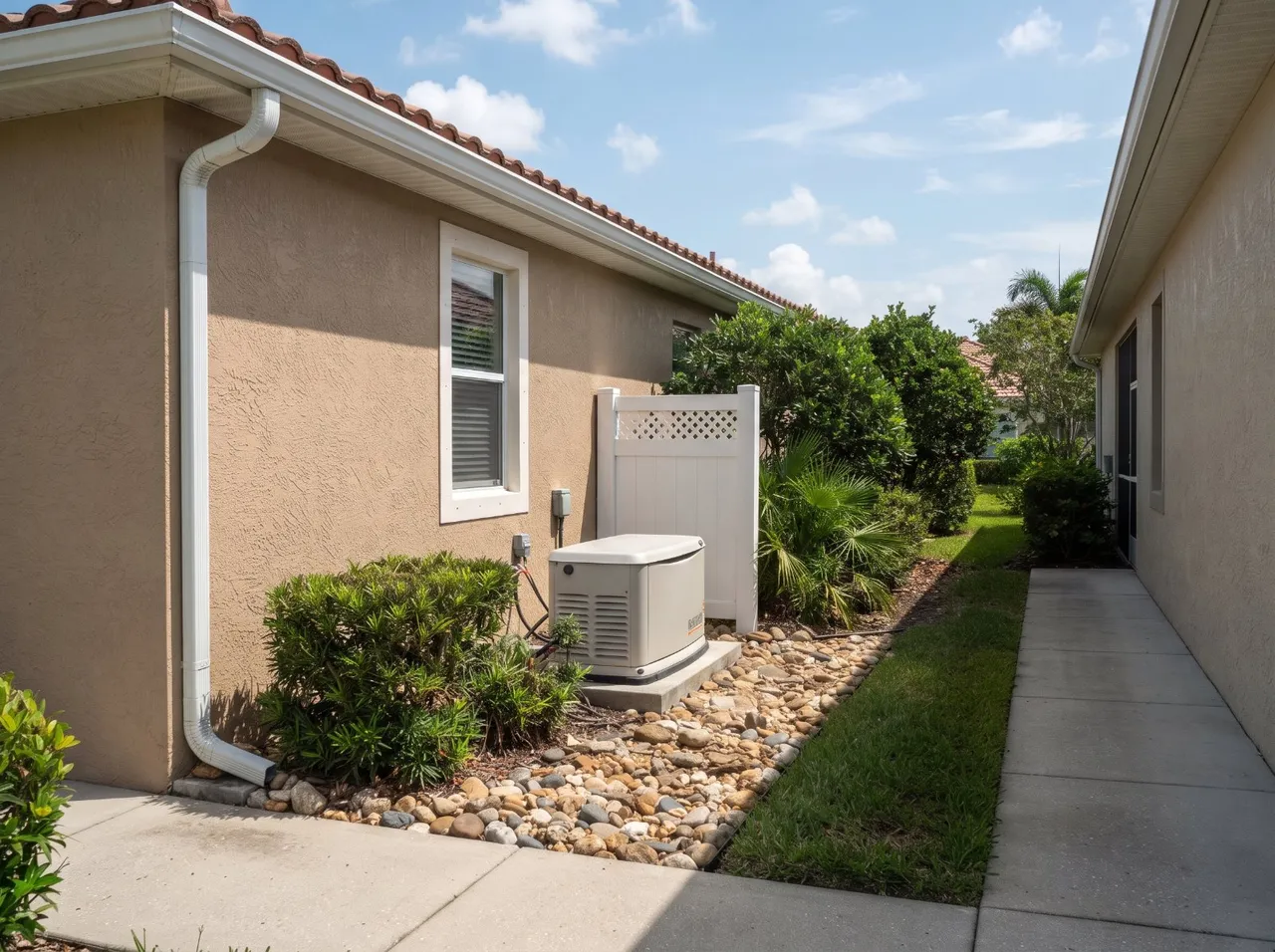
Why courtyard villas are the hardest fit
Free in-home estimate, written price, no obligation.
Get my estimateCourtyard villas pack a lot of home onto a small lot, and the ARC manuals protect the shared spaces between them with their own clauses. Before anyone talks brands, it helps to know which parts of the lot are off the table.
The District 1 ARC manual has a set of rules written just for courtyard villas:
- The front yard. The courtyard villa front yard is all the area in front of the gate, and no modifications are allowed there apart from landscaping and a few corner-lot exceptions.
- Side easements. Courtyard villas have a dominant side easement (your side yard to enjoy) and a servient one (your side yard burden for the neighbor). The manual allows no vertical structure of any kind in either, and keeps structures at least 5 feet from the side property line on the dominant side.
- The rear easement. No vertical structure of any kind is permitted in rear easement areas.
- Walls facing the neighbor's courtyard. Adding doors or windows to the side of the home that faces the adjacent home's dominant use easement or courtyard is prohibited.
Residents notice this. Posters on a June 2024 Talk of The Villages thread about home standby generators said window clearances are hard to meet on villas. They are right that it is tight. It is also usually solvable, once the installer maps the easements and the manufacturer's clearances on the same drawing.
Your district's manual may word these clauses differently, and the ARC staff interpret them for your lot. Bring the plat or site plan to the estimate if you have it.
The manufacturer clearances, in plain numbers
The ARC rules say where a generator may go on the lot. The manufacturer's clearances say how close it may sit to the house and to anything that burns. Both have to be met.
Generac's clearance guidance, which cites NFPA 37, lists:
- 5 feet from openings. Operable windows, doors, vents, window wells and other openings in a wall.
- 18 inches to a wall. From the back of the generator to a stationary wall or building, but only for units marked with the Southwest Research Institute (SwRI) logo. Units without that mark follow the standard clearances in the installation manual.
- 5 feet above. Open space over the unit, so no low eaves or overhangs.
- 3 feet at the front and both ends. Including trees, shrubs and bushes.
Generac adds that local codes take precedence, that a unit must not go under a wooden deck or platform, and that even a compliant distance may still let carbon monoxide into a home, so the unit may need to sit farther away and gaps around windows and doors should be sealed.
Kohler's 26RCA spec sheet says the unit meets NFPA guidelines for 18 inch clearance to combustible materials and tells installers to check state and local codes for the minimum distance from a structure.
On a villa, the 5 foot rule from windows and doors is usually the one that decides the spot. A side wall with no windows near the rear corner is often the best candidate, as long as it is not inside an easement. Your installer measures, reads the model's installation manual, and confirms the code edition your building office enforces.
The ARC generator rules on a villa lot
On top of the villa easement clauses, the general generator rules in the manuals apply to courtyard villas too. The District 1 manual lists them under homes, courtyard villas and patio villas alike:
- Rear or side only. Permanently fixed generators go in the rear or the side of the home site.
- 2 feet off all property lines. On a narrow lot, that 2 feet comes out of already scarce space.
- Not visible from the street. Equipment that can be seen from the street must be concealed with a fence or landscaping.
- Screening no taller than the generator. A fence can hide it but cannot rise above it.
- Exhaust away from neighbors. The exhaust must point away from the adjacent properties, which on a villa means thinking hard about which way the unit faces.
- A modest pad. Pads for generators no larger than necessary must stay 2 feet from the property lines.
Put those next to the villa clauses and the picture gets clear. The usable zone is often a short stretch of side yard outside the easements, or a rear corner outside the rear easement, at least 2 feet from the lines and 5 feet from any window or door. Some lots have a good spot. Some have only one. A few may have none that meets every rule, and an honest installer will tell you that up front.
The ARC application should show all of it on one site plan. See the ARC approval page for what goes in the packet.
Milton left 21,912 Sumter County accounts without power at the 8:47 AM report on Oct. 10, 2024 (Florida PSC), and small lots went dark the same as large ones.
Neighbors a few feet away: walls, windows and exhaust
Villa life means a neighbor's wall, window or lanai may be close to any spot you pick. A few points keep a generator a good neighbor.
- Their windows count too. Generac's guidance is about openings in walls, and carbon monoxide does not care whose wall it is. Ask your installer to measure to the neighbor's windows and vents as well as yours.
- Exhaust direction. The ARC rule is that exhaust points away from the adjacent properties. On a villa, that often decides which way the unit faces as much as where it sits.
- Sound at short distance. Generac lists its 26 kW at 67 dB(A) at 23 feet under normal load, and 57 dB(A) in its Quiet-Test exercise mode. Kohler lists its 26RCA at 56 dB(A) during exercise and 67 dB(A) in normal operation at 23 feet. On a villa, the neighbor's bedroom may be closer than 23 feet, so it will sound louder there. Our noise page covers exercise timing and screening.
- Attached homes. If your villa shares a wall with the next home, the shared wall, the neighbor's openings and the exhaust path all need checking on the drawing.
- A heads-up helps. Tell the neighbor what is coming and when the weekly or biweekly self-test will run. Most people mind noise less when they know to expect it.
One more thought: during a long outage, your neighbor's home is hot and dark too. Checking on them, especially anyone living alone or on oxygen, is part of being the house with the lights on.
Compact units and fuel on a tight lot
It is natural to assume a smaller generator takes less space. Often it does not. Generac's spec sheets list the same 48 by 25 by 29 inch enclosure for its air-cooled 10, 14 and 18 kW units and its 20, 22, 24 and 26 kW units. Kohler lists its 26RCA at about 47 by 26 by 32.3 inches. Briggs and Stratton lists its PP26 at 46 by 27 by 28 inches assembled. The footprints are close, so pick the size by what you need to run, not to save a few inches.
Fuel is where villas differ most:
- Natural gas. If your villa has a gas meter, a gas line from the meter is usually the cleanest fit, with no tank to place. The utility checks that the meter and regulator can carry the generator plus your appliances. See the natural gas page.
- Above-ground propane. The ARC manuals allow one above-ground tank of up to 120 gallons, hidden from the road and neighbors and out of easements. On a villa, finding a hidden spot for both a tank and a generator is a real puzzle. A full 120-gallon tank runs a Generac 26 kW about 47 hours at half load.
- Buried propane. Permitted by the manuals, but a fire marshal summary of NFPA 58 lists 10 feet from the building and buildable property line for underground tanks, which most villa lots cannot meet.
Because villa fuel is often limited, load management matters. A unit that sheds the second air conditioner or the water heater while the main air conditioner runs uses less fuel and can be sized smaller. Our sizing guide helps you decide what must run.
Placement options to bring to the estimate
Every villa lot is different, but installers tend to look at the same handful of spots. Knowing them helps you have a better conversation at the estimate.
- The rear corner. Often the best candidate if it sits outside the rear easement, away from windows, and out of view from the street.
- Beside the gas meter. A short gas run saves pipe and labor, if the spot clears windows and easements.
- Near the existing air conditioner pad. The manuals treat air conditioner and generator pads the same way, so a spot near the condenser may already fit the pattern, as long as the clearances work.
- A windowless side wall. Where the generator can sit 18 inches from a solid wall (on an SwRI-marked unit) and 5 feet from any opening.
Questions worth asking your installer:
- Which spots did you rule out, and why?
- Which easements cross my lot, and where are their lines?
- How far will the unit be from my windows and my neighbor's?
- Which way will the exhaust point?
- Is this model SwRI-marked for the 18 inch wall clearance?
- What fuel do you recommend, and how many hours will it run at my loads?
- What will the ARC see on the site plan?
If no spot meets every rule, a good installer says so and explains the alternatives, such as a battery system for essentials or a portable plan. Our battery comparison and portable comparison cover those honestly.
Straight answers
Free in-home estimate, written price, no obligation.
Get my estimateCan I put a generator at a courtyard villa in The Villages?
Often, yes, but the spot is limited. It must meet the manufacturer's clearances, such as 5 feet from windows and doors, and the ARC manual's rules: rear or side, 2 feet from property lines, hidden from the street, and outside the villa's front yard and side and rear easements. A licensed installer maps all of it before suggesting a location.
How close can a generator be to my villa wall?
Generac's guidance allows 18 inches from the back of the unit to a stationary wall, but only for units marked with the SwRI logo. It also calls for 5 feet from operable windows, doors and vents, 5 feet above, and 3 feet at the front and ends. Local codes take precedence, and your installer checks the model's installation manual.
Can the generator go in my side yard easement?
The District 1 manual allows no vertical structure of any kind in a courtyard villa's dominant or servient side easements, and keeps structures 5 feet from the side property line on the dominant side. That usually rules out the easement areas. Your district's manual and ARC staff have the final word for your lot.
Is a smaller generator easier to fit at a villa?
Not by much. Generac's spec sheets list the same 48 by 25 by 29 inch enclosure for its air-cooled 10 to 26 kW units, and Kohler and Briggs 26 kW units are close in size. Choose the size by what must run during an outage, then use load management to keep fuel use down.
Will my neighbor hear the generator?
Probably, a little. Generac lists its 26 kW at 67 dB(A) at 23 feet under normal load and 57 dB(A) in Quiet-Test exercise mode. On a villa, a neighbor may be closer than 23 feet. Pointing the exhaust away, as the ARC requires, scheduling the self-test at a considerate time and giving the neighbor a heads-up all help.
Can I have a propane tank at a villa?
The ARC manuals allow one above-ground tank of up to 120 gallons, hidden from the road and neighbors and kept out of easements. Buried tanks are permitted, but a fire marshal summary of NFPA 58 lists 10 feet from the building and buildable property line, which few villa lots can meet. Natural gas, where available, is often the easier fit.